It's Sunday. Slow blog day. Time to catch up on a couple of things.
I do not like housekeeping. I do not like blog housekeeping, either. I like the writing and the posting and the commenting. I hate the housekeeping. I've been neglecting it. But! Here I am, trying to straighten things up just a bit.
Two little things I need to share, both in the Shameless Self-Promotion Department. (If there's anything I'm worse at than housekeeping, it's self-promotion. Really. So I'm really going out on a limb with this. Please make it worth my while.)
The first is embarrassing. I was messing around with Feedburner this week and, um, totally screwed up the link. So if you subscribe, your subscription was probably lost. (Yet one more reason I am not a computer engineer....) I set it all back up again and promise never, ever to touch it again. So just please subscribe. Again.
Second: Twitter. Yep, it's true. I love it! And now I've dusted off my old account and am actually using it. I opened it a few months ago and then didn't do a thing with it. But now I need some help. Please note, to your right, the "Follow me on Twitter" button. Click it. Follow me. I have embarrassingly few followers, but I'm new. Help my fragile ego.... Follow me! (And, need I remind you? Three boys. Ridiculous things happen around here all the time. Probably you want the details.)
Okay, that's it. That's all the housekeeping and groveling I can take for one day. See you on Twitter.
Sunday, February 22, 2009


Thursday, February 19, 2009
Out sick
This isn't a post. It's an anti-post. It's a post about why it's not a post.
Okay, fine then: it's an excuse.
But you see? This is still kicking my butt. And I could live with drowning in my own snot and sounding like I've been smoking four packs a day since I was three and with the frequent attempts to actually cough up lung tissue. But another symptom seems to be that I have been robbed of all motivation to remain upright or awake. I am pathologically tired.
And I have to dig deep, because I have to be "on" all weekend. Because my husband is working two 24-hour on-call shifts at the hospital so I get to be single mom extraordinaire. And it's Pinewood Derby weekend, people! (And let's not be mistaken: I will use those as further excuses as to why I will not be posting for a few days.)
Shoot. me. now.
So. Instead of posting (because remember: this is not a post) I'm going to take a nap now.
Back soon.
Okay, fine then: it's an excuse.
But you see? This is still kicking my butt. And I could live with drowning in my own snot and sounding like I've been smoking four packs a day since I was three and with the frequent attempts to actually cough up lung tissue. But another symptom seems to be that I have been robbed of all motivation to remain upright or awake. I am pathologically tired.
And I have to dig deep, because I have to be "on" all weekend. Because my husband is working two 24-hour on-call shifts at the hospital so I get to be single mom extraordinaire. And it's Pinewood Derby weekend, people! (And let's not be mistaken: I will use those as further excuses as to why I will not be posting for a few days.)
Shoot. me. now.
So. Instead of posting (because remember: this is not a post) I'm going to take a nap now.
Back soon.
Tuesday, February 17, 2009
For Real: The First Cut
The first time wasn’t the worst. But it was bad enough.
The ceiling must have been a hundred feet high, and I was tiny, floating in an endless outer space of a cold green room. Everywhere I looked was institutional, antiseptic green: a color reserved for prisons and junior high schools and hospitals. And blinding sunlight poured in the windows. Except it couldn’t have been sunlight. Could it? It must have been the lights, as far away and as bright as the sun, because operating rooms don’t have windows. There were voices, but no faces. Voices that yelled from far away, but I knew they were talking to me because sometimes I heard my name. I couldn’t see clearly, could barely hear in the thin, electric air.
A cliché: I was too scared to cry. My naked little body shivered on the table, only a sheet covering me. But I couldn’t cry, or speak. I wanted to ask someone to hold my hand. But my tears and my voice were squashed back into me by the weight of the fear and the enormous space.
Earlier, in my room, they had made me take off all my clothes. “Can I keep my underwear?” I wanted to know. I would have felt safer with my underwear. “No,” the orderly said. So I lay on a bed, utterly naked, and he covered me with the sheet and some people came and pushed me to a freight elevator which took us up six flights to the operating room. I shivered the whole way.
Years later, when I was a nurse at the same hospital, we used that same freight elevator to transport dead bodies to the basement morgue. They were naked, too, covered only with a sheet. I used to wonder if they could feel the cold.
In the strange green operating room, a voice told me it was time to go to sleep. A mask was pushed down onto my nose and mouth, and I couldn’t breathe. I shook free, shook my head "no." It was shocking, how bad the mask smelled, how bad its air tasted: like rubber, like alcohol, like poison. Again the mask, and I did not want to breathe. I fought. “Count backwards from 100,” someone yelled, “and you’ll fall asleep before you get to one.” I didn’t want to, and shook my head again. But then I breathed the poison and counted because I was supposed to and because I was a good girl.
“100, 99….”
I made it to 93.
But they lied: it wasn’t like falling asleep. It felt violent, like my wakefulness was forced out of me, like my head was being held underwater. Ultimately I couldn’t have fought anymore, even if I had tried. I thought I was going to die, but I counted backwards like I was told.
While I lay unconscious in that operating room, my parents sat in the waiting room. They sat for too long, and they knew it. Something was wrong. They knew. When my surgeon finally did emerge, he looked their way, then shook his head and turned and walked away.
Something was wrong.
My father recently told me that he has always felt fortunate for the life he’s led. Except for that moment. When my doctor couldn’t face them, Dad said, it was the worst moment of his life. That, he said, made him question.
But the surgeon returned and explained. He didn’t understand what he had found inside of me. He didn’t know what to do. The tumor was trying to kill me. But he was afraid that by doing something, anything, he might kill me. So they took biopsies and closed me back up.
He couldn’t fix me.
Later, after I was sewn together, I fought to wake up. I was still shivering, I was vomiting, I was crying. I wanted my mom, and then she appeared through the anesthetic fog. I wanted my underwear, and the nurse laughed at my request, and then put them on me and I felt warmer. I slept again and the horrible poisonous medicine slowly evaporated from my body.
When I was a nurse there, twenty years later, I used to sneak away from my shifts in the ICU. Sometimes in the middle of the night I would visit the old operating room, long since abandoned and converted to a storage area. And I would sit in the corner on the cold tile floor and breathe deeply and try to turn time backwards. I tried to remember. I tried to listen. I looked for my terrified eight-year-old self in that eerie, deadly quiet space.
I never found her.
And because I never found her there, I started to wonder. Had I imagined the fear, the cold, the bewilderment? Could it really have been that bad?
A few years ago, I stumbled across a plain and frightened piece of my little girl self. I was sorting through papers from my childhood, and among my third-grade math worksheets and my eight-year-old's drawings, I found it.
It was a neatly folded note, written to my mother on the eve of my second hospitalization. Large, deliberate child's script, in bright blue marker, mistakes crossed out, with tear stains blotting some of the careful words.
When I read that, I knew. It had all been real. I had been as scared as I remembered. The note was a simple testament to how bad that first time had been.
And I didn't even know how much worse things would get.
The ceiling must have been a hundred feet high, and I was tiny, floating in an endless outer space of a cold green room. Everywhere I looked was institutional, antiseptic green: a color reserved for prisons and junior high schools and hospitals. And blinding sunlight poured in the windows. Except it couldn’t have been sunlight. Could it? It must have been the lights, as far away and as bright as the sun, because operating rooms don’t have windows. There were voices, but no faces. Voices that yelled from far away, but I knew they were talking to me because sometimes I heard my name. I couldn’t see clearly, could barely hear in the thin, electric air.
A cliché: I was too scared to cry. My naked little body shivered on the table, only a sheet covering me. But I couldn’t cry, or speak. I wanted to ask someone to hold my hand. But my tears and my voice were squashed back into me by the weight of the fear and the enormous space.
Earlier, in my room, they had made me take off all my clothes. “Can I keep my underwear?” I wanted to know. I would have felt safer with my underwear. “No,” the orderly said. So I lay on a bed, utterly naked, and he covered me with the sheet and some people came and pushed me to a freight elevator which took us up six flights to the operating room. I shivered the whole way.
Years later, when I was a nurse at the same hospital, we used that same freight elevator to transport dead bodies to the basement morgue. They were naked, too, covered only with a sheet. I used to wonder if they could feel the cold.
In the strange green operating room, a voice told me it was time to go to sleep. A mask was pushed down onto my nose and mouth, and I couldn’t breathe. I shook free, shook my head "no." It was shocking, how bad the mask smelled, how bad its air tasted: like rubber, like alcohol, like poison. Again the mask, and I did not want to breathe. I fought. “Count backwards from 100,” someone yelled, “and you’ll fall asleep before you get to one.” I didn’t want to, and shook my head again. But then I breathed the poison and counted because I was supposed to and because I was a good girl.
“100, 99….”
I made it to 93.
But they lied: it wasn’t like falling asleep. It felt violent, like my wakefulness was forced out of me, like my head was being held underwater. Ultimately I couldn’t have fought anymore, even if I had tried. I thought I was going to die, but I counted backwards like I was told.
While I lay unconscious in that operating room, my parents sat in the waiting room. They sat for too long, and they knew it. Something was wrong. They knew. When my surgeon finally did emerge, he looked their way, then shook his head and turned and walked away.
Something was wrong.
My father recently told me that he has always felt fortunate for the life he’s led. Except for that moment. When my doctor couldn’t face them, Dad said, it was the worst moment of his life. That, he said, made him question.
But the surgeon returned and explained. He didn’t understand what he had found inside of me. He didn’t know what to do. The tumor was trying to kill me. But he was afraid that by doing something, anything, he might kill me. So they took biopsies and closed me back up.
He couldn’t fix me.
Later, after I was sewn together, I fought to wake up. I was still shivering, I was vomiting, I was crying. I wanted my mom, and then she appeared through the anesthetic fog. I wanted my underwear, and the nurse laughed at my request, and then put them on me and I felt warmer. I slept again and the horrible poisonous medicine slowly evaporated from my body.
When I was a nurse there, twenty years later, I used to sneak away from my shifts in the ICU. Sometimes in the middle of the night I would visit the old operating room, long since abandoned and converted to a storage area. And I would sit in the corner on the cold tile floor and breathe deeply and try to turn time backwards. I tried to remember. I tried to listen. I looked for my terrified eight-year-old self in that eerie, deadly quiet space.
I never found her.
And because I never found her there, I started to wonder. Had I imagined the fear, the cold, the bewilderment? Could it really have been that bad?
A few years ago, I stumbled across a plain and frightened piece of my little girl self. I was sorting through papers from my childhood, and among my third-grade math worksheets and my eight-year-old's drawings, I found it.
It was a neatly folded note, written to my mother on the eve of my second hospitalization. Large, deliberate child's script, in bright blue marker, mistakes crossed out, with tear stains blotting some of the careful words.
“Dear Mommy,
I’m scared and don’t want to go to the hospital. Last time I was
really scared. I am scared this time, too.
Your Daughter,
Teresa”
When I read that, I knew. It had all been real. I had been as scared as I remembered. The note was a simple testament to how bad that first time had been.
And I didn't even know how much worse things would get.
Monday, February 16, 2009
Rising to the Brussels sprouts challenge
This is what happens when my kids say to me (in the produce aisle): "Mom, what are those little cabbage-looking things?"
Really, they should know better. They've lived with me their entire lives. They should know that, before they know what hit them, those little cabbage-looking things will end up in our shopping cart. And they should also know that, before they can say "Ewwww," those little cabbage-looking things will be on their dinner plates. Because I will not back down from a challenge. They should know.
True to form, I met this challenge. Without further ado, my kids eating Brussels sprouts:
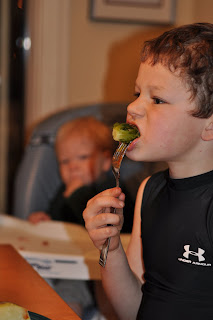

Really, they should know better. They've lived with me their entire lives. They should know that, before they know what hit them, those little cabbage-looking things will end up in our shopping cart. And they should also know that, before they can say "Ewwww," those little cabbage-looking things will be on their dinner plates. Because I will not back down from a challenge. They should know.
True to form, I met this challenge. Without further ado, my kids eating Brussels sprouts:


They loved them.
Evan had four helpings. Four. I had to tell him to leave some for the rest of us. Even Jensen (who was initially pretty sure I was trying to poison him) had, like, two and a half servings. I'm guessing it didn't hurt that I braised them in bacon fat and apple cider and garlic and thyme, but I figured I only had one chance to make a first impression. You do what you gotta do. The fact remains: my kids love Brussels sprouts.
Ladies and gentlemen, my work here is done. Now, if you'll excuse me, there's a little economic crisis that needs to be addressed, and then some heads need to be screwed on straight in Congress. And if I have some extra time, I may zip on over to the Middle East.
I'll be home in time for dinner.
Friday, February 13, 2009
Now I'm a research scientist
I heard the NIH is getting a bunch of cash in the pending stimulus package. I'm sure they think they have plenty of good uses for the money, but I have a proposal: a Department of Domestic Biochemistry. This is my first scholarly submission. Though not exactly ground-breaking, I don't think anyone can possibly deny its scientific merit.
The Efficacy of Mothers as a Growth Medium for Pediatric Pathogens
It is generally believed that children are carriers of, if not infected with, a wide variety of virulent pathogens continually between the months of October and April annually. It is also commonly believed that children, because they are filthy little beasts, are highly effective transmitters of these pathogens. This article examines the efficacy of child-maternal disease transmission.
Methods
Test group: One (1) female mother, age 39, was individually innoculated with the organism Nares Verdi Snotulinum in the following manner: a single pediatric vector, age one year, deposited a nose full of bright green nasal mucous ("snot") into his mother's mouth by placing his nose directly into her mouth and blowing. Snot transfer rate was 100%.
Control group: One (1) male father, age 34, was not innoculated.
Results
Innoculation occured on Day One (Monday) at 1700 hours. No maternal changes were noted on Days Two and Three. On Day Four (Thursday) at 1500 hours, the mother reported subjective changes such as fatigue and mild headache. Within two hours she was sitting motionless in a living room chair with measurable nasal congestion, while her children ran wild and ate alarming amounts of candy and played "toss the baby." By 1945 hours (ahem, 7:45 pm, people) she was unconscious in bed in her pajamas with a box of tissues, displaying all signs of fulminant Nares Verdi Snotulinum infection. The control group remained (of course) asymptomatic.
Extensive statistical analysis showed a 100% correlation between the following variables: motherhood, placement of pediatric snot in mouth, and upper respiratory infection.
Conclusion
In the experimental household, if a child is displaying symptoms of the "common cold," he will with 100% reliability deposit infected mucous on the mother, and she will also become infected within 72-96 hours. In the majority of cases the father will remain disease-free. No further research on this topic is warranted.
The Efficacy of Mothers as a Growth Medium for Pediatric Pathogens
It is generally believed that children are carriers of, if not infected with, a wide variety of virulent pathogens continually between the months of October and April annually. It is also commonly believed that children, because they are filthy little beasts, are highly effective transmitters of these pathogens. This article examines the efficacy of child-maternal disease transmission.
Methods
Test group: One (1) female mother, age 39, was individually innoculated with the organism Nares Verdi Snotulinum in the following manner: a single pediatric vector, age one year, deposited a nose full of bright green nasal mucous ("snot") into his mother's mouth by placing his nose directly into her mouth and blowing. Snot transfer rate was 100%.
Control group: One (1) male father, age 34, was not innoculated.
Results
Innoculation occured on Day One (Monday) at 1700 hours. No maternal changes were noted on Days Two and Three. On Day Four (Thursday) at 1500 hours, the mother reported subjective changes such as fatigue and mild headache. Within two hours she was sitting motionless in a living room chair with measurable nasal congestion, while her children ran wild and ate alarming amounts of candy and played "toss the baby." By 1945 hours (ahem, 7:45 pm, people) she was unconscious in bed in her pajamas with a box of tissues, displaying all signs of fulminant Nares Verdi Snotulinum infection. The control group remained (of course) asymptomatic.
Extensive statistical analysis showed a 100% correlation between the following variables: motherhood, placement of pediatric snot in mouth, and upper respiratory infection.
Conclusion
In the experimental household, if a child is displaying symptoms of the "common cold," he will with 100% reliability deposit infected mucous on the mother, and she will also become infected within 72-96 hours. In the majority of cases the father will remain disease-free. No further research on this topic is warranted.
Thursday, February 12, 2009
For real: Claiming what is mine
I wanted to be able to look in the mirror. That was all. It seems simple enough. But it took me the better part of a decade to be able to do that one little thing.
My ultimate goal, I suppose, was larger than just the mirror: I wanted to not hate myself. Even more: I wanted to accept myself. But before I could accept myself, I had to accept my face. Before I could accept my face, I had to be able to look at it in the mirror.
And twenty years ago, I could not do that.
I hated the way I looked, hated myself, so badly that I couldn't even look at myself. I simply did not do it. I never looked at a picture of myself. (If you think you hate pictures of yourself, try being me for a moment or two.) And mirrors posed a problem. Of course, I couldn't avoid mirrors. But I developed an uncanny ability to look at only half of my face. Or to look at my reflection without really internalizing what was there. I could brush my hair or wash my face while literally looking at only the right side of my face. I learned to put on make-up without really seeing beyond the mechanics of the application. It became second nature. (The vision in my left eye is drastically worse than my right eye. Sometimes I wonder if it's because I just stopped using it.)
I knew what was there, of course, in the mirror and on my face: an ugly scar, a large hole, a drooping eye, an unmoving mouth. I knew these things. But I did my best not to associate these things with myself. I never really looked. I was scared of the details, terrified of the whole. In the mirror, and perhaps everywhere else, I was half a face.
This was not how I wanted to be. I wanted to look at myself. I wanted to see what others saw. I wanted to face the truth. I wanted to be complete.
So I fought.
It took years. I increased the scope of my vision in the mirror by literally a fraction of an inch at a time. I would take a quick peek at my sunken ear, or at my sagging lower eyelid, and I would be paralyzed. I would be ill. I would cry. I would be unable to look again for weeks. I was sickened by what I saw. I did not want this person to be me.
But as devastating as it seemed at times, as much self-hate as I was forced to own, as deeply as it challenged my sense of who I was... I did not give up. I fought, for years. And I won.
And I thought I was done.
My soul settled. I had a successful career. I married, had children. I flourished in loving and in being loved. I busied myself with the day-to-day issues that distract all parents. After a lifetime of grief and rage and hiding, the issues surrounding my face slid into the background.
And I was more than happy to let it go. I was happy to be at peace, happy to be normal, happy to be just another boring mom. I was happy to be able to ignore that part of myself. I was happy.
But it wasn't over.
As I said, my ultimate goal had always been self-acceptance. And I had come a long way. I could leave the house. I could tolerate the public stares. I knew what I looked like. These were no small feats.
But even though I had come a long way toward my goal, I had never told my entire story to anyone, not even to myself. I was finally able to look in the mirror, but I wasn't able to tell the story of the person who looked back at me.
So here I find myself. I have begun to tell the story. It is not easy. Sometimes as I write I shake. Sometimes I cry. Sometimes I get sick. But I've done it all before. Just as I had to struggle to face the mirror, I will struggle to tell my story.
My silence about my face has been profound. I am putting forth memories that I have never shared. I tucked them away years ago, never planning to revisit them. I would much rather forget them.
But they haven't gone away. My story hasn't gone away. For three decades I have kept this story to myself. I can't be complete until the people in my life know me. For real.
I have been overwhelmed by your kindness and encouragement. I never thought anyone would care about this. So to those of you who have commented, here or on Facebook, to those of you who have e-mailed, to those of you who have called, to those of you who have just read in silence: thank you. That's all I can say. I'll keep telling the story as I am able, but in the meantime: thank you. You will never know what you have done for me....
My ultimate goal, I suppose, was larger than just the mirror: I wanted to not hate myself. Even more: I wanted to accept myself. But before I could accept myself, I had to accept my face. Before I could accept my face, I had to be able to look at it in the mirror.
And twenty years ago, I could not do that.
I hated the way I looked, hated myself, so badly that I couldn't even look at myself. I simply did not do it. I never looked at a picture of myself. (If you think you hate pictures of yourself, try being me for a moment or two.) And mirrors posed a problem. Of course, I couldn't avoid mirrors. But I developed an uncanny ability to look at only half of my face. Or to look at my reflection without really internalizing what was there. I could brush my hair or wash my face while literally looking at only the right side of my face. I learned to put on make-up without really seeing beyond the mechanics of the application. It became second nature. (The vision in my left eye is drastically worse than my right eye. Sometimes I wonder if it's because I just stopped using it.)
I knew what was there, of course, in the mirror and on my face: an ugly scar, a large hole, a drooping eye, an unmoving mouth. I knew these things. But I did my best not to associate these things with myself. I never really looked. I was scared of the details, terrified of the whole. In the mirror, and perhaps everywhere else, I was half a face.
This was not how I wanted to be. I wanted to look at myself. I wanted to see what others saw. I wanted to face the truth. I wanted to be complete.
So I fought.
It took years. I increased the scope of my vision in the mirror by literally a fraction of an inch at a time. I would take a quick peek at my sunken ear, or at my sagging lower eyelid, and I would be paralyzed. I would be ill. I would cry. I would be unable to look again for weeks. I was sickened by what I saw. I did not want this person to be me.
But as devastating as it seemed at times, as much self-hate as I was forced to own, as deeply as it challenged my sense of who I was... I did not give up. I fought, for years. And I won.
And I thought I was done.
My soul settled. I had a successful career. I married, had children. I flourished in loving and in being loved. I busied myself with the day-to-day issues that distract all parents. After a lifetime of grief and rage and hiding, the issues surrounding my face slid into the background.
And I was more than happy to let it go. I was happy to be at peace, happy to be normal, happy to be just another boring mom. I was happy to be able to ignore that part of myself. I was happy.
But it wasn't over.
As I said, my ultimate goal had always been self-acceptance. And I had come a long way. I could leave the house. I could tolerate the public stares. I knew what I looked like. These were no small feats.
But even though I had come a long way toward my goal, I had never told my entire story to anyone, not even to myself. I was finally able to look in the mirror, but I wasn't able to tell the story of the person who looked back at me.
So here I find myself. I have begun to tell the story. It is not easy. Sometimes as I write I shake. Sometimes I cry. Sometimes I get sick. But I've done it all before. Just as I had to struggle to face the mirror, I will struggle to tell my story.
My silence about my face has been profound. I am putting forth memories that I have never shared. I tucked them away years ago, never planning to revisit them. I would much rather forget them.
But they haven't gone away. My story hasn't gone away. For three decades I have kept this story to myself. I can't be complete until the people in my life know me. For real.
I have been overwhelmed by your kindness and encouragement. I never thought anyone would care about this. So to those of you who have commented, here or on Facebook, to those of you who have e-mailed, to those of you who have called, to those of you who have just read in silence: thank you. That's all I can say. I'll keep telling the story as I am able, but in the meantime: thank you. You will never know what you have done for me....
Wednesday, February 11, 2009
Not wordless. But it is Wednesday.

This, I suppose, is filler.
I was going through old photos yesterday, looking for something else, but I kept coming across photos of Jensen. Insanely adorable photos of my first-born. Photos that I remember like they were yesterday. Photos that are almost eight years old.
How could I not share?
Plus I had to get yesterday's humiliating post about my undies off the front page.
Subscribe to:
Posts (Atom)

 Posts
Posts


